
Inside SugarHill's Analog Echo Chambers
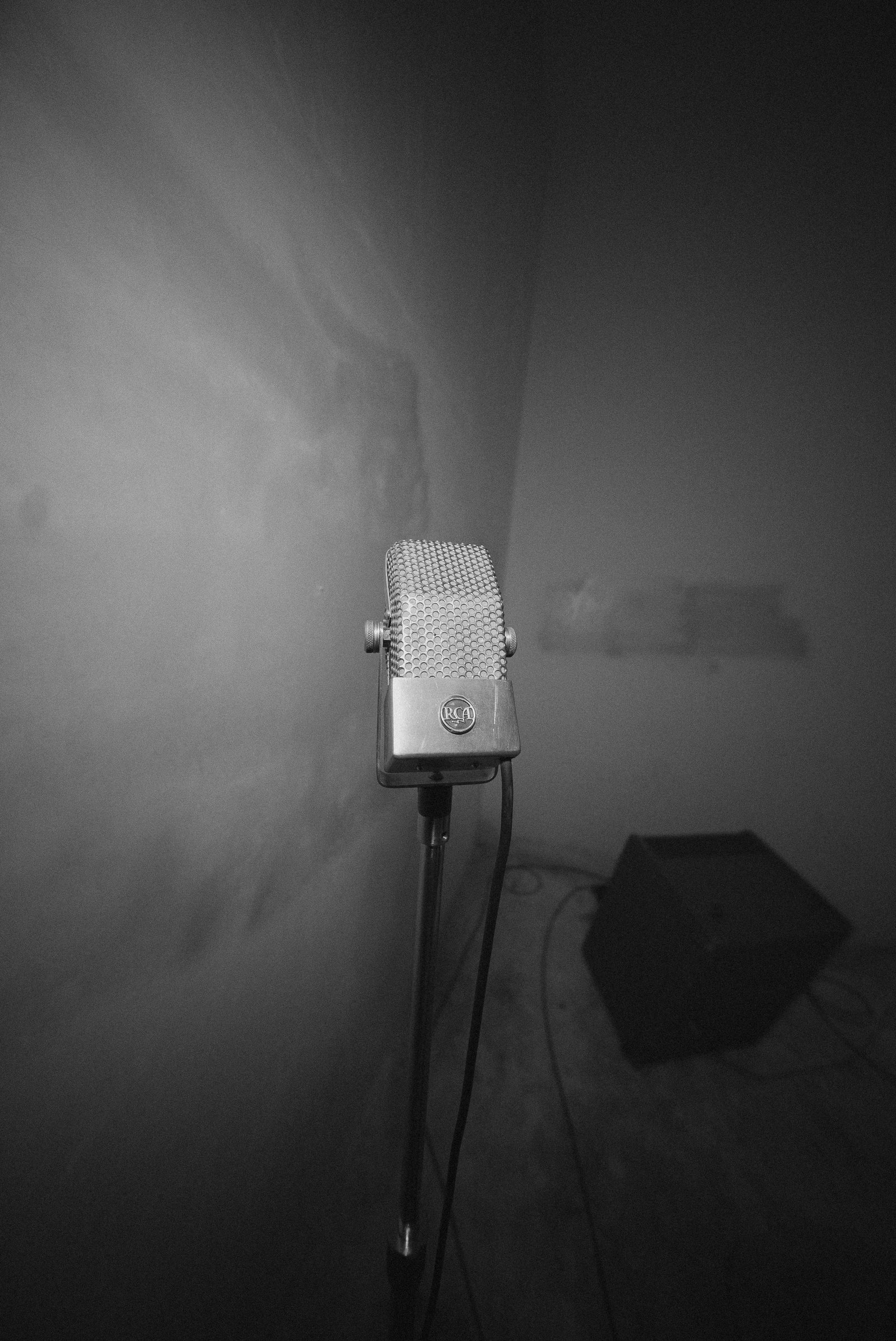
Every reverb you have ever used started as a room. Before the plugin, before the rack unit, before the plate, there was a hard empty space with a speaker at one end and a microphone at the other. That is the whole invention. And at SugarHill Recording Studios in Houston, that room is still standing, still wired, and still printing on records in 2026. We are one of the few places left in the country where you can book an analog echo chamber recording studio session and hear your voice come back wearing a real space instead of a math problem. Ours were designed in 1964 by Jack Clement — the engineer who came up out of Sun Studios in Memphis — and built out when Gold Star Studios was completed on Brock Street. They are miked with an Altec 604E and an RCA 44. They have been running since Lyndon Johnson was president.
How an Echo Chamber Actually Works
The concept is almost stupidly simple, which is exactly why it has never been beaten. A signal leaves the console — a vocal, a snare, a horn line — and goes out to a loudspeaker sitting inside a sealed, hard-surfaced room. The sound leaves that speaker and starts bouncing. Concrete, plaster, tile, whatever the walls are made of, they reflect nearly all of the energy back into the space instead of absorbing it. A microphone placed down the length of the room picks up the original sound plus the thousands of reflections piling up behind it. That mic feeds back to the desk, where the engineer blends it against the dry track. The details are where it gets interesting. Move the mic farther from the speaker and you get more reverb relative to the source. Angle the walls so no two surfaces are parallel and standing waves stop building up, which is what keeps the decay smooth instead of ringing on one note. Point the mic away from the speaker and you capture reflection instead of direct sound. Every one of those choices is a knob you can turn, except the knob is a physical decision in a physical room. That is the part no plugin fully reproduces. A chamber is not a setting. It is a performance.
The Records That Made Chambers Famous
Artificial reverb has a birthday. In 1947, Bill Putnam ran a signal into the bathroom at Universal Recording in Chicago's Civic Opera Building and recorded "Peg o' My Heart" by the Harmonicats with the echo blended in. It is credited as the first artistic use of artificial reverb on a popular record, and it sold something like 1.4 million copies. Putnam went on to found Universal Audio — the same name now printed on half the plugins in your session. Everyone chased that sound afterward. Atlantic Records famously got some of its most iconic soul and R&B reverb out of an office bathroom. Bruce Botnick used the same trick recording the Doors for L.A. Woman in 1971. Bill Haley's early hits got their bloom from cutting under the domed ceiling of a converted ballroom in New York. The studios with money built chambers on purpose. Abbey Road, opened in 1931 as one of the first purpose-built recording facilities anywhere, has kept its chamber in place for the better part of a century. Capitol Studios in Hollywood buried eight of them thirty feet under the parking lot — trapezoidal, thick concrete, finished in hard lacquer, capable of about five seconds of decay, with the first four designed by Les Paul in 1956 and four more added in 1969. Demand was so high that Capitol used to lease chamber time to other studios remotely over telephone lines. Think about that: studios were renting a room in another building just to borrow its air. And then there is the cautionary tale. The Hollywood studio called Gold Star — no relation to Houston's Gold Star, which is us — built a legendary pair of trapezoidal chambers roughly twenty feet across and eighteen feet long, walls of thick specially formulated cement plaster, accessed through doors barely two feet square. Those chambers are on the Wall of Sound, on "Good Vibrations," on parts of Pet Sounds. The studio closed in 1984. The chambers went with the building. That is what usually happens. Real estate wins. A chamber takes up enormous square footage and generates no revenue when it is idle, so when a lease turns over, the chamber becomes storage or a hallway or a parking spot. Ours didn't.
Why Chambers Still Beat the Boxes
Spring reverb arrived with a Hammond patent in 1939. Plates followed in the late 1950s with the EMT 140. Digital reverb showed up with the EMT 250 in 1976 and took over the eighties. Convolution — sampling a real space as an impulse response and rebuilding it digitally — didn't get a real-time hardware processor until Sony's DRE S777 in 1999. Every one of those was an attempt to bottle what a chamber does for less money and less floor space. They are all useful. We own plenty of them; there is an EMT 240 Gold Foil plate in Goldstar, a Lexicon 300, an Eventide H3000, TC M5000 and M2000, a rack of PCM units. We reach for all of it. But here is the honest technical difference. An impulse response is a photograph of a room. It captures how that space responded to one test signal, from one speaker position, at one mic position, at one level, on one day. It is a snapshot, and it is frozen. A real chamber responds differently depending on how hard you drive the speaker, where the mic is standing, what the humidity is doing, and what else is going on inside it. Send a screaming vocal into a live chamber and the room loads up differently than it does with a whisper. That non-linear, slightly unpredictable behavior is the thing engineers describe as "depth," and it is the thing samples flatten out. When you print a track through our chambers, you are not recalling a preset. You are recording a room in Houston that has been absorbing sound since 1964, on the same floor where Lightnin' Hopkins, the Big Bopper, the 13th Floor Elevators, Freddy Fender, Destiny's Child, Beyoncé and Travis Scott all cut. Send a snare out there and it comes back with the building attached to it.
We're Building Plugins From Our Own Chambers
Here is what we are working on now. We are in the process of developing plugins made from the actual signal of our analog reverb chambers — capturing these rooms directly, at the source, so their character can travel outside of 5626 Brock Street for the first time in six decades. There is precedent for exactly this. Universal Audio released officially licensed emulations of four Capitol echo chambers in 2019, and producers who will never set foot in Hollywood have been using that sound ever since. What has never been captured is the Houston version. The chambers that put echo on Texas blues, on Cajun hits, on Texas psych, on Gulf Coast soul, on decades of Houston rap — that decay has only ever existed in one building, and only ever been available to people who booked the room. We want to change that, carefully. Not a generic hall preset with our name on it. Our chambers, our mics, our signal path, captured properly. The project is in development and we are not putting a date on it yet. What we will say is that everything in it comes out of the same rooms you can book right now, which is the part that matters. The plugin will be a copy. The chamber is the original.
Come Hear It Yourself
The chambers are available from all three of our rooms — the Sugar Hill Room with its 36-input NEOTEK console, Goldstar with the Neve Genesys Black, and the Duke Room on the Avid D-Command. You can run a lead vocal through them, a snare, a horn section, a guitar, a whole mix bus if you want. Most engineers who visit ask for the same thing on their first session: send something out there and let me hear it come back. It never takes more than one pass to understand why we kept the room. Eighty-five years in, the tape is still rolling at 5626 Brock Street. Book a session and put your record through a piece of American recording history that is still, somehow, plugged in.
BOOK A SESSION · Call 713-926-4431
Come cut a record.
Tell us what you are making and when you want the room. Call 713-926-4431 or book online.
Book a Session