
Vintage Microphone Locker at Houston's Oldest Studio
Most studios have a couple of Neumanns and a story about them. Open the cabinet at SugarHill and you find something stranger: a row of microphones stamped RFT and Gefell, made in a country that no longer exists, sitting a few inches from the Neumanns made by the other half of the same company after a wall went up between them. Almost nobody in American recording has this. The vintage microphone locker in Houston that we've built over eighty-five years contains one of the more unusual East German collections you'll find in a working studio — not behind glass, not for show, but on stands, in sessions, this week. Here's how those two halves came apart, and how they ended up back together in the East End.
A Bomb, a Textile Factory, and a Company Cut in Two
In 1943, an incendiary bomb destroyed most of Georg Neumann's Berlin microphone factory. Neumann fled to Gefell, a small town in Thuringia, taking his family, his technical director Erich Kühnast, his legal adviser and around twenty employees with him. They set up in an abandoned textile factory and kept building the microphones they'd been making in Berlin since the 1930s — including the M7 capsule, developed by Walter Weber and Hans Joachim von Braunmühl of the German state broadcasting organization. That capsule is one of the foundational objects in recorded sound. It's the capsule in the original U47. By 1948 the military had released Neumann's Berlin property and he moved back, founding Georg Neumann GmbH. For the next thirteen years the company effectively operated in two places at once, Berlin and Gefell. Then in 1961 the Berlin Wall went up, and the two workshops were separated — not by business strategy but by concrete, barbed wire and geopolitics. The Berlin operation became the Neumann the world knows: U47, U67, U87. The Gefell operation was stuck on the other side. In 1972, under pressure from the East German government, the Gefell company was nationalized and renamed VEB Mikrofontechnik Gefell. Its microphones went out under the RFT brand, and they supplied studios and measurement labs across the Eastern bloc. By the late 1980s the factory had grown to roughly 160 employees, and the government funded an entirely new building for it. Western engineers, meanwhile, barely knew these microphones existed. The most remarkable detail: Gefell never stopped hand-making the M7 capsule the way Neumann personally taught the elder Kühnast in the 1940s — hand-drilling each hole in the backplate, making the PVC membrane, gluing it together by hand. Three generations of the Kühnast family have now run the place. They still make it that way.
Both Halves Are in Our Cabinet
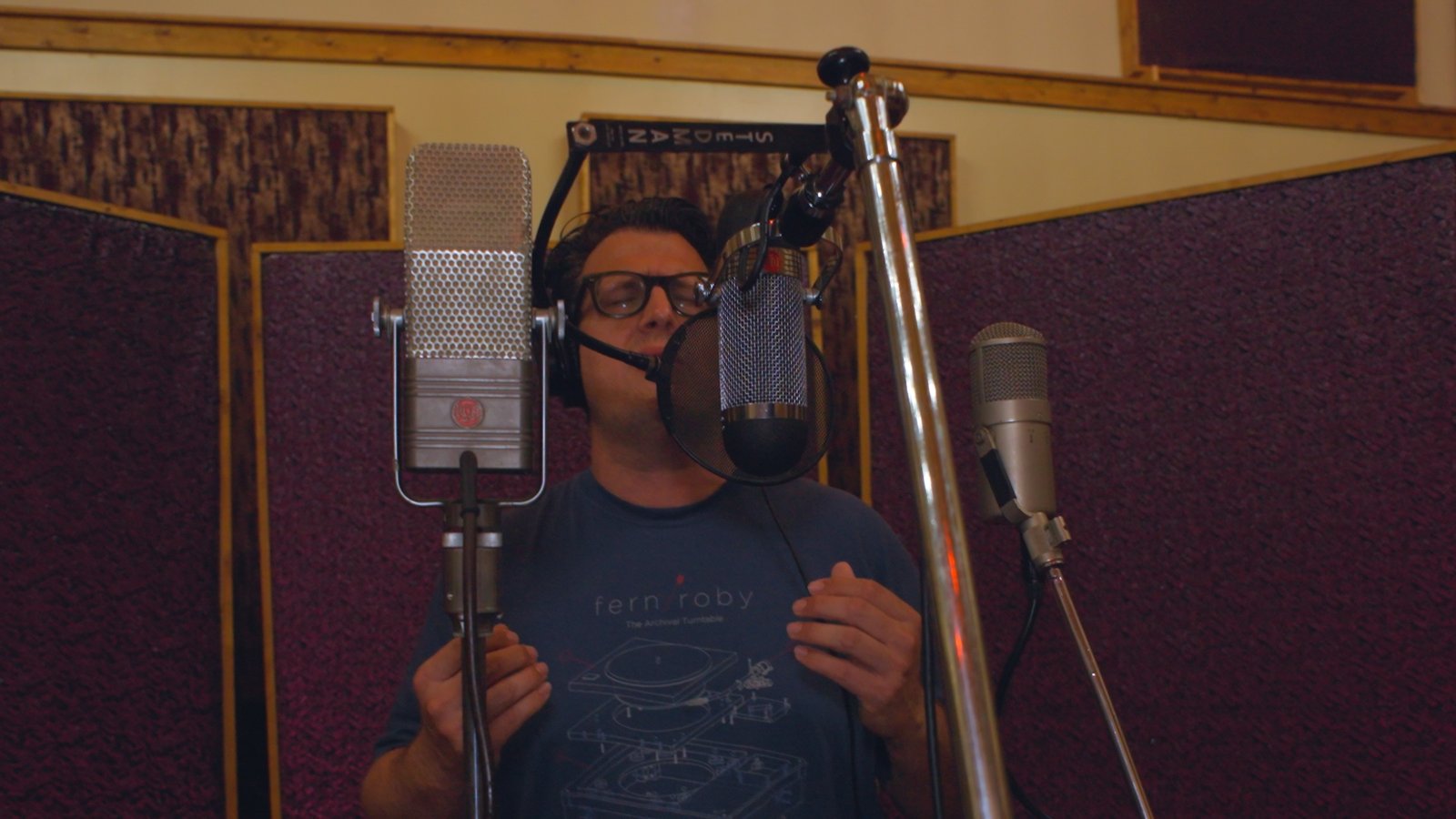
From the western side of the Wall, the locker holds two Neumann U47 FETs, several U87s including a vintage example and a Bradley-modified silver, three KM84s, two KM86s and a KM184. From the eastern side: RFT UM70s and UM70S bodies, Gefell 691 and 692 series pieces, several MG582 variants including a UM70-modded one, an RFT 7151 with its power supply, plus RFT M94s, an M93, M70s and a handful of DM622s. The UM70 is the one engineers get excited about. It's a multi-pattern condenser built around that same M7 capsule lineage — the ancestor of the sound everybody chases with a U47 — but it came out of a nationalized East German factory and sold for a fraction of the price in the West for decades. It's excellent on acoustic guitar and on both male and female vocals, with a detailed, slightly drier character than the Berlin mics. Not a substitute for a U47. A cousin with a different accent.
The Rest of the Continent Is In There Too
Once you start pulling drawers, the collection stops being German and becomes European. The dynamics run deep on Sennheiser: four MD421s, three MD441s, plus an MD408 and MD416 from the older broadcast era. Ribbons include two Beyerdynamic M500s and an M260 alongside the RCA 44, RCA 77 and BK-5B. Austria shows up as an AKG C28 with an SE30CB body and a full spread of the C451 family. France arrives as Bouyer 709 and 720. There's a Philips 9020 from the Netherlands, five Uher M537s and a pair of obscure Funkberater MD30s. And it isn't only microphones. The outboard carries RFT W735/1 equalization, an RFT V240/1a line amp and TAB V376b preamps — meaning you can build a signal path that is European broadcast gear from the capsule all the way to the console. That combination is the actual point. Any studio can buy a new mic. Very few can offer you a chain where the microphone, the preamp and the EQ all came out of mid-century European radio engineering.
Ask for the Shootout
If you're tracking here, ask your engineer to set up three or four options on your source and let you hear them back to back before you commit. It costs fifteen minutes and it is the single highest-value thing you can do in a session. Most artists arrive assuming they want the most expensive mic in the building. Then they hear their own voice through a sixty-year-old microphone built in a nationalized factory in a country that dissolved in 1990, and they change their mind. Come find out which one is yours.
[BOOK A SESSION] · Call 713-926-4431
Come cut a record.
Tell us what you are making and when you want the room. Call 713-926-4431 or book online.
Book a Session